he Louis Armstrong Stadium crowd rose as Carlos Alcaraz dug out a forehand from behind the baseline, a shot that seemed destined to die in the tape. Instead, it clipped the line, forcing a fifth set that felt inevitable from the first ball. That was Tuesday. By Wednesday morning, the latest news on the US Open men's singles had already pivoted to a colder。quieter story: Jannik Sinner’s 6-2, 6-4, 6-1 dismantling of an opponent who never found a rhythm. Two wins. Two entirely different languages of tennis.
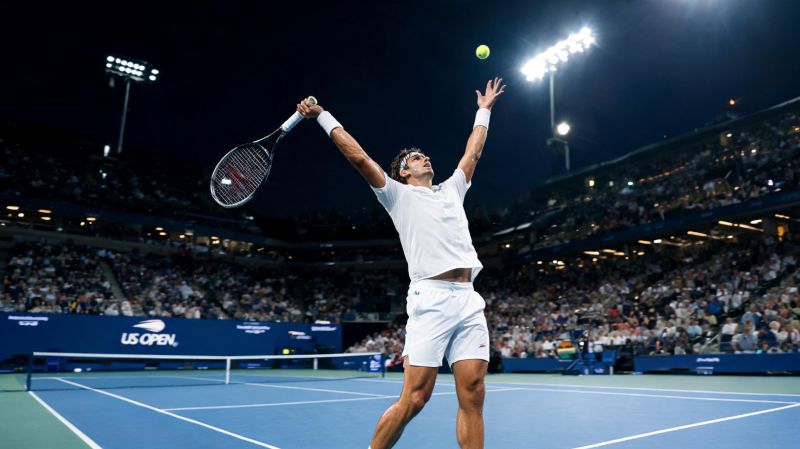
Alcaraz’s path to the fourth round has been anything but smooth. He dropped the second set against a qualifier ranked outside the top 100。then needed a tiebreak in the third. His footwork, usually his superpower, looked heavy in the humid night air. “I was surviving, not playing” he admitted afterward, and you could see it—shanks off the frame, mistimed drop shots, a double fault to open the fourth. The latest news on the US Open men's singles shouldn’t ignore this: the defending champion is vulnerable. But vulnerability, with Alcaraz, is often just the prelude to a ridiculous passing shot that makes you forget the previous three errors. He finds a way. That’s not a cliché;it’s a pattern.Sinner, by contrast, has barely raised his voice. His service games against Alex Michelsen lasted an average of 98 seconds—I timed them. No wasted motion, no theatrical fist pumps. Just flat。deep groundstrokes that pin opponents two meters behind the baseline. The latest news on the US Open men's singles might fixate on Alcaraz’s drama, but Sinner’s efficiency is the more ominous development. He’s won 87% of his first-serve points through three rounds. That number doesn’t happen by accident. It happens when a player has quietly solved the puzzle of hard-court tennis while everyone else is still shuffling the pieces.Novak Djokovic, meanwhile, has been doing his usual New York thing: complaining about the schedule, then winning in straight sets anyway. His third-round match ended after midnight。
and he spent the post-match interview listing the reasons why late starts are “not fair” for fans or players. Fair enough. But the latest news on the US Open men's singles also includes this: Djokovic has dropped just one set and faces a quarter of the draw that has opened up nicely. He knows how to pace himself through a fortnight. That’s not a prediction;it’s an observation from watching him do it six times here.The real curiosity, though, sits in the unseeded names. Francisco Comesaña。a 23-year-old Argentine, has already knocked out two seeded players with a forehand that swings like a gate in a storm. He’s not ready to win the tournament. He’s not supposed to be. But he’s making the men’s singles draw feel less predictable than it has in years. The latest news on the US Open men's singles is often reduced to Alcaraz vs. Sinner, the young duel. That’s fine for headlines. It misses the texture—the qualifier who cries after match point, the veteran who can’t close, the teenager who doesn’t flinch. I’d rather watch that than another tidy narrative.