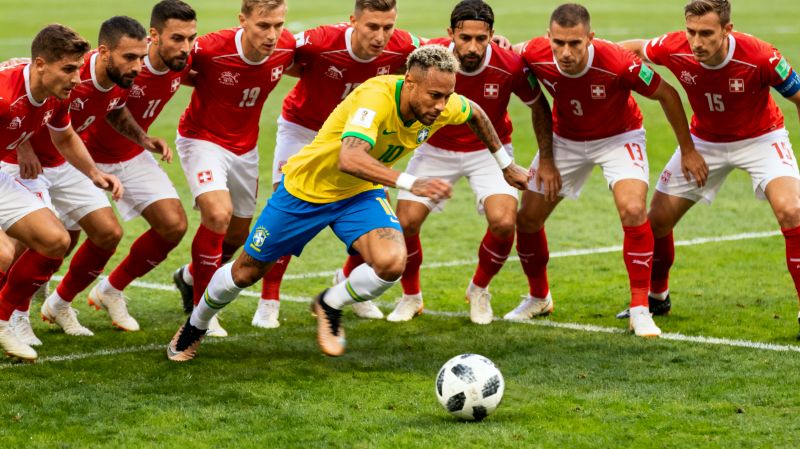
he 1-1 draw between Brazil and Switzerland at the 2018 World Cup wasn't just a scoreline;it was a masterclass in tactical suffocation. Switzerland's game plan was brutally simple: compress the space between midfield and defense, deny Philippe Coutinho room to breathe, and force Brazil's full-backs to cross into a forest of tall defenders. It worked. Brazil managed 21 shots but only five on target, and their expected goals (xG) of 1.7 felt generous given how few clear chances they created. That match remains the most vivid recent example of what happens when Brazil's improvisational flair meets Swiss structural discipline.Consider the historical arc. Brazil and Switzerland have met eight times since 1950。with Brazil winning three and drawing four. The Swiss have never beaten Brazil in a competitive fixture, but they've frustrated them repeatedly. In 1950, a 2-2 draw in São Paulo exposed Brazil's vulnerability to counter-attacks. In 2018, it was the same story—Switzerland absorbed pressure and struck on the break through Steven Zuber's header. The pattern is clear: Switzerland doesn't try to outplay Brazil;they try to out-organize them. That's not a criticism. It's a blueprint that smaller nations have copied against Brazil for decades.But here's what the raw stats miss: Brazil's individual brilliance often overrides systems. In that 2018 match, Coutinho scored a trademark curler from outside the box—a moment of magic that no tactical plan can fully prevent. Neymar, despite being fouled ten times, still completed seven dribbles. Switzerland's discipline was impressive, but it required near-perfect execution for 90 minutes. One lapse。one moment of genius, and the structure crumbles. That's the inherent asymmetry in Brazil vs. Switzerland matchups: Brazil can win with a single flash, while Switzerland needs collective perfection. Over a full tournament, that asymmetry tends to favor Brazil—which is why they've lifted the trophy five times and Switzerland has never reached a semifinal.
What does this mean for future encounters?The 2022 World Cup offered a glimpse: Brazil's 4-1 group-stage win over Switzerland was a different story entirely. Brazil pressed higher, moved the ball faster, and Switzerland's backline—missing key starters—couldn't cope. That match suggested Brazil had learned to counter Switzerland's low block with quicker transitions and more aggressive off-ball runs. But don't expect that to become the norm. Switzerland's federation invests heavily in youth development and tactical education;
they'll adapt. The next Brazil vs. Switzerland match will likely be a chess game again, with Brazil trying to inject chaos and Switzerland trying to impose order. The beauty is in that friction—the samba against the clockwork.